|
| Western Rattlesnake, Crotalus oreganus |
17 August, 2010
Big Sur Rattlesnake


19 January, 2010
Big Asilomar
Monterey, California. Terrific storm systems have been moving through Monterey Country for the past couple of days, generating tons of rains, hail, lightening strikes and a really big swell. The storm system, which is expected to persist for awhile, is believed to be a result of the strong El Niño event rocking our world this year. Below is a little video footage from one our local surf breaks, Asilomar, maxing out at 35ft this morning.
07 January, 2010
Wild Climate
 Merida, Mexico and Copenhagen, Denmark. In recent months I've been neglecting this blog, but am now jump-starting a new look and direction. In upcoming posts, you'll see an increased emphasis on a wilderness ethic and less of a day to day account of my activities. Instead, I'd like to present you with written and video dispatches from the field, some current and some from stock-piled footage that I've been sitting on for months. The important thing is to live wild - make this a celebration of the natural world around us. I hope you'll join me in this adventure.
Since you last heard from me, I've been in the city of Merida (Yucatan, Mexico), participating in Wild9, the 9th World Wilderness Congress. Shortly after, I traveled to Copenhagen, Denmark to participate in COP15 - the 15th Conference of Parties to the United Nations Framework Convention on Climate Change (UNFCCC) - representing the Center for Ocean Solutions as a part of the Stanford University delegation to the Conference. While there, I was blogging via the Center's climate blog, which you can check out at the:

One of the exciting outreach activities of Copenhagen was to launch a new multimedia short entitled Oceans +2C. This video, on which I served as Executive Producer, was a collaboration between the Center for Ocean Solutions and the iLCP (International League of Conservation Photographers). It was also a wonderful opportunity to re-engage my good friend, Cristina Mittermeier, as well as work with a wide range of new friends and colleagues. Enjoy the video here:
05 January, 2010
04 October, 2009
Elk Rut
Rocky Mountain National Park, Colorado. Last weekend I had the wonderful opportunity of camping and filming within Rocky Mountain National Park during the elk rut. Here is a small teaser of the footage - more to come!
05 August, 2009
Beautiful Central California

The story behind the first video "A Message to Boca" is pretty simple. Our buddy, Boca, was going to come along on the trip, but bailed at the last minute. The references for signs are due to the fact that, well, he makes signs for a living. The second video is pretty self explanatory. It's Death Rabbit. Unleashed.

11 June, 2009
An After Work Hike

Soberanes Canyon Trail, Garrapata State Park, California. Location of trailhead: Latitude 36.4387, Longitude -121.9203.

The signs at the trailheads in this region warn of mountain lions, rattlesnakes and poison oak. I seem to be impervious to the latter and am only exhilarated by the possibility of seeing the first two. I consider these types of signs to be more about the “best stuff to see” as opposed to any message of caution I should heed. A few years back, while hiking at Kenai Glacier in Alaska, I was amazed and amused by the bear warning signs posted by the National Park Service. Apparently, if at any times a bear “begins to feed on you”, you should “fight back”. Brilliant! To be fair though, the rest of the sign did give some pretty good advice as well as helpful information on the behavioral differences between black and brown bears.

Now, on the trails here in Central California, I did end up seeing one of those rattlesnakes. It was this past Easter, while on a hike through Garland Ranch Regional Park, in Carmel Valley. It was a small guy, for sure, but my very first rattler, so I was thrilled. Today, on the other hand, I had no such luck, but nonetheless was not left disappointed.
After leaving work at 5pm in Monterey, I headed down the PCH past Carmel Heights to a beautiful ocean overlook where the trailhead for Soberanes Canyon Trail begins. You enter Garrapata State Park as soon as you walk off the road, but this is evident only from a single sign post – there are no facilities or elaborate trail markers here. The trail winds up the canyon, following a stream along the way and , at this time of day, the air was buzzing with damselflies and stellar jays. After briefly passing through oak chaparral, the canyon winds through a valley of prickly pear cactus, through some riparian vegetation and then empties into a magnificent redwood forest a la the moon of Endor (minus any signs of Ewoks).
After spending some time among the redwoods, billows of fog began to roll in and the sky darkened with the approaching dusk. I had a mind to turn around, but noted that a few couples that passed me by while I stopped for photos had not come back this way. So, I guessed a loop trail and moved onward. I was greatly rewarded, as the best was yet to come. The trail eventually rises up from the redwood forest and onto the grassy slopes above tree line. From this vantage point, one can see how the redwood groves line the interiors of narrow canyons, and then quickly fade off as the slopes open up. The trail here rises high into the Santa Lucia Mountains, the slopes of which are alive with wildflowers at this time of the year. California poppies, composites and lupines were a few I recognized, but my recollection does not do them justice. It is a orgy of color up there and, as one climbs higher, a spectacular vista of the sea opens behind you, making the Pacific look like nothing more than a great, glassy pond.


Continuing upward, I feared that I had chosen wrongly as dusk settled deep on the backside of the mountain. But as I neared the summit, a still late afternoon sun greeted me, illuminating the rocky outcrops and flowered slopes in bright gold, scattered almost mystically through patches of fog. Although far above the sea now, the bellows of sea lions could yet be heard, their raucous barking radiating from an offshore pair of islets. I encountered a rabbit, a black-tailed deer and numerous western fence lizards.

The descent is on the front side of the mountain, exposed to the sun and ocean, so barren of trees. In one obscure spot, a carved bench sits on an outcropping. Through a friend I heard that on one night of every week, hikers meet here with bottles of wine to watch the sun go down. I had no wine, but the sun did set for me as I descended back down to the road. Funny, I kind of regret not having been caught up there past dark - I’d love to still be roaming those hills.

28 April, 2009
New Home in Monterey
Monterey, California. Over the past couple of weeks I have been relocating my entire life from Los Angeles to Monterey by way of Florida. I've also switched from a PC to a Mac. Here is a ridiculous video clip of my new home. It was my first attempt fooling around with iMovie, thus the overuse of transitions and silly sound effects...
03 April, 2009
Back to Cali
 San Francisco, California. After a cross-continental flight from Florida yesterday, it seems I am back in California again. And this time apparently for good. In coming weeks, I'll be starting a new job on the Central Coast and will post an update here as that develops.
 In the meantime, if you are following this season of 24, keep an eye out for Rick Schimmelpfenneg and me (Arlo Hemphill) this coming Monday in the showdown scene at the Starkwood complex.

Rick plays a Starkwood Op and I'm a Navy Seal, in camo and face paint. If you want to pick either of us out, you may need to employ your pause button and a magnifying glass. The scene is dark and judging from its beginnings in last week's episode, one guy in camo and face paint looks like them all...
Also, if you haven't yet caught the episode of Spike TV's 1,000 Ways to Die "Death Gets Busy" - you have another opportunity. Watch me die of cocoa inhalation this Sunday night (April 5th) at 7:00pm.
On other fronts, I'm now on Twitter! Follow me at: http://www.twitter.com/arlohemphill. Finally, the Name Your Dream Assignment Contest is winding down. Your vote for Patagonia See is much appreciated before time runs out!
16 March, 2009
To Sea Patagonia

Melbourne, Florida. The Patagonia Sea (southwestern Atlantic), is one of the most spectacular marine ecoregions on the planet. What it lacks in biodiversity, it more

than makes up for in productivity and immense aggregations of marine wildlife. Elephant seals, penguins, sea lions, whales and other megafauna congregate in mass in what can only be referred to as wildlife spectacles. But like many parts of the ocean today, this sea is in trouble. Overfishing, harmful fishing practices, pollution and inadequate management measures threaten this unique area, much of which is still poorly understood.
As a means to raise awareness on and document the conservation status of the Patagonian Sea coast, I am proposing an expedition to traverse Argentina’s coastline from north to south by non-motorized means. Traveling by kayak and foot (and possibly to a limited extent horseback, bicycle and sail), I plan take photographs, video,

interviews and collect scientific data on water quality and biodiversity along the way. My proposed starting point for this journey will be the magnificent Iguaçu Falls at the intersect of Brazil, Argentina and Paraguay. From there, I will work my way by kayak down the Rio Paraná, important in terms of its role as the major source of freshwater discharge into the Patagonian Sea.

Upon reaching the Rio de la Plata, I will then set out by foot, from Buenos to Tierra del Fuego. And this journey is intended to be shared with you. As often as possible, I will upload blog/vlog posts here and on my wilderness blog Walk on the Wild Side. This will be the first stage of a dream to transform this blog from sideline reporting on wilderness news, to an actual day to day account of walking through the wild.
You can help make this dream a reality by voting online for Patagonia See at the Name Your Dream Assignment contest! Additionally, the expedition is in need of all kinds of support ranging from in-kind donations of website construction, to field gear, to actual monetary donations that will support the travel, science and subsistence costs. Please feel free to direct any inquiries or offers of support or collaboration to me, Arlo Hemphill: arlo@arlohemphill.com

The impetus behind this adventure stems from my belief that our oceans are in dire trouble. One means to combat this crisis is to address human activities on the ocean at the scale of large marine ecosystems, of which the Patagonian Sea represents a distinct unit.

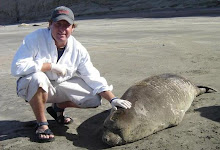
But this adventure is also the culmination of a passion that was instilled in me for the wildlife and landscape of Patagonia. I first visited the region in early 2005 when, as a marine program manager for Conservation International, I was invited down to explore some of the wild coastline. It was love at first sight. And my first visit shortly turned into a regular relationship as a steering committee member on the Forum for the Conservation of the Patagonia Sea and Areas of Influence. The pictures of me included with this post are from that time.
One of my fondest adventures in the region was with Dr. Claudio Campagna, director of the Wildlife Conservation Society's Sea and Sky Program. I joined Claudio on the Peninsula Valdes and with him had the opportunity to track down a tagged southern elephant seal Mirounga leonina using radio telemetry. The young seal in question also wore a satellite tag and our quest was to remove this tag to access the invaluable oceanographic data collected over a season at sea. In the picture above the young female is temporarily incapacitated after being tranquilized for the removal of the device. The photo here to the right was taken on one of Patagonia’s Estancias, which are large shepherding ranches.

The animal in my company is a young guanaco Lama guanicoe, one of South America’s four species of camel. This particular individual was semi-domesticated, living in association with the Estancia. However, these animals range wild throughout this landscape and are bountiful.
Looking ahead, I see the most challenging portion of this trek to be the lower third of the Argentine coast. It is a wild, harsh landscape with low human population density and miles upon miles of trackless, near-desert wilderness. It is this, and the unknown that lies therein, that draws me more than anything. I appreciate your help in moving this adventure forward and I look forward to sharing this time with you through this blog.
Photo Credits: Arlo and elephant seal (Natalia Machain), Maps of Argentina (Forum for the Conservation of the Patagonian Sea and Areas of Influence, www.worldatlas.com, MSN Encarta), Iguaçu Falls (Wikipidia), Arlo and guanaco (Rodolfo "Bubu" Werner)
Subscribe to:
Posts (Atom)