24 July, 2011

Are Writers Better Behind Bars?

Arlo in "Checkmate"
Arlo as the Chessboard Killer in the independent film "Checkmate"
Marina, California. On Friday The New York Times featured an essay entitled Why Writers Belong Behind Bars. It's a fascinating look at what makes some writers especially prolific and how forced imprisonment has often catalyzed the most productive years of writer's lives. The article then leads into the somewhat more light topic on techniques of modern writers to self-impose periods of isolation. An especially interesting aspect of the piece was how the modern era of the Internet causes a constant problem for serious writers in that it's a constant distraction. For all of the benefits it offers writers - connections with other authors and publishers, unlimited research potential, and a means to get their work out - it can also be an enormous hindrance to productivity as even the most disciplined of souls are tempted to check e-mails, chat on Facebook or simply catch the latest breaking news - via video no less! Some writers have taken extreme measures to combat this, even shutting off Internet access for large blocks of the day and altering computer equipment so the World Wide Web cannot be accessed. This is a challenge I understand all too well and think many of us out there - writers or not - can relate to. How do you reap the benefits of the information age without succumbing to its dark side charms? I think the writers profiled in the essay are a little braver than I - but it's definitely something to consider!

On another level, I found the piece to have personal relevance under my present circumstances. I'm by no means imprisoned, but my life here in Marina is a great deal more restricted than I've ever been accustomed to. In jest, my roommate Tali Manouki and I often refer to it as "The Manouki Prison". I'm just kind of sequestered in a no man's land of fog and abandoned military buildings, without a lot of immediate options for getting out and exploring the wider world. Unlike the Marquis de Sade barricaded in the Bastille, my present situation will change dramatically in a few months time. But in this period of temporary isolation, could I be better using my time and talents to churn out some big writing projects? I'd like to hope so. In addition to my travel writing work for Gogobot and the various natural history consultancies I currently have under my belt, I'm looking at a few major book projects. Check out these concepts I'm working on and, if you have a moment, I'd appreciate any feedback on your thoughts:

The California Project - is what I'm calling a currently unnamed effort to reflect on the duality of beauty and horror that is the modern State of California. It's part memoir, part essay on this great state that so many people both love and hate. Writing from the personal perspective of my four tumultuous years here, I want to look at both the golden allure of it's natural beauty and economic wealth as well as the corrupted and bankrupt underbelly of the State system that threatens to take this whole place to hell. I've had a unique set of experiences here - from international conservation efforts, oceanographic studies, acting and producing films in Hollywood, getting a sour taste for the broken legal system, and working with everyone from local non-profits and major universities. I've also had one-on-one close encounters with a whirlwind menagerie of hippies, dot com entrepreneurs, celebrities, scientists, politicians, filmmakers, struggling actors, meth addicts and surfers - the smorgasbord of all that epitomizes California, crammed into a few short years! Is this a story you'd be interested in hearing?

Broken Leashes and Fake Ice Cream - is one of numerous working titles I have for a collaborative effort on short surf travel tales. Written from the alter-ego nickname of LoBag Rex, along with my buddies Rabbit and Boca, we want to share the best, worst and funniest of our haphazard and totally unplanned adventures throughout Latin America over a 15 year time frame. It's meant to be a collection of short stories from the voice of three surfer adventurers, looking for good waves and good times in foreign lands. I can't wait to get started on this one - it's fun just talking about! What do you think?

OK, I gotta get back to my cell now...

Big Deal

Big Sur River Gorge 
Life along the Big Sur River Gorge
Big Sur, Calfornia. Few sensory pleasures compare to dipping into a cool mountain river on a scorching hot summer day. During my past four years in California, this has been my ultimate indulgence. To get away from the hustle and bustle of life for a day, bake in California's warm interior on a scenic hike or bike ride, and then spend the rest of the day drifting in pure bliss within crystal clear mountain waters - is a pleasure hard to put words to. A favorite spot in the past has been the Russian River of Sonoma Valley, but the Big Sur River in July does the job just fine. Recently, my buddy "Rabbit" Schaffer and I made our way to Pfeiffer Big Sur State Park and did a few hours of hiking on the dramatic - but terribly exposed - Mount Manuel trail. After a few hours baking in the Big Sur July heat along windless canyons of the Ventana Wilderness, we made our way back to the Park, scrambled down into the Big Sur River gorge and rock-hopped upstream until we found a swimming hole to our liking. Crystal clear, these waters are important for steelhead and were all too recently a favorite haunt for California's now extinct grizzly bear population. For us, it was summertime at its best. A swim beneath waterfalls, followed by sipping a few rounds of Argentine mate upon massive boulders, and then more swimming. Before long, all of the biting flies, snakes, poison oak and scorching sun of the Ventana backcountry had been washed from our souls. Heaven must be a little like this.

View Larger Map

 
Big Sur River swimming hole
Big Sur River


Arlo sipping mate - Big Sur River Gorge
Arlo sipping mate in the Big Sur River Gorge
Rabbit on Mount Manuel
Rabbit runs down the Mount Manuel Trail
Rabbit & his mate
Rabbit sipping mate in the Big Sur River Gorge
Arlo & Rabbit, Big Sur River
Arlo & Rabbit relax in the Big Sur River - post excursion

24 March, 2011

Exploration as Art

A blind river fish from the Rio Bameno, Amazonian Ecuador.  Known as "wiami" to the local Huaorani.
Mountain View, California.  Beyond all else, exploration is my greatest passion. It is the process of discovery with risk. It provides the opportunity to experience what few others have and the potential to witness that which no one else has. It is both the hazy cloud of the unknown and the shining beacon of enlightenment. And to me it is worth any cost.

Unidentified mantis at the Bilsa Biological
Station.  Mache-Chindul Range,
Western Ecuador.
Exploration is an art. Like all forms of art, it is a means of self-expression, discovery and a reflection of reality. It is also the tool by which I paint the picture of my life. The means through which I tell stories in written word and film. It is an ever-changing landscape on a kaleidoscope of color, culture, geology, climate and biodiversity. It is a deep crevasse of self-awareness, the mechanism for finding one’s own place in this world and understanding the texture of our souls. Nothing shows you who you are quite like that which you are most not. Exploration places you in intimate proximity with your counterbalance. It entwines who you are with who you are not, with who you may be and most of all, who you appear not to be, but in fact share almost everything. In doing so, exploration catalyzes the creation of something new. This creation is artistic expression of life in its purest form.

The author, Arlo Hemphill, straddled with a killed peccary during a hunt with the Huaorani.  Amazonian Ecuador, 2003.

22 March, 2011

I am Wilderness

Pico Blanco, Ventana Wilderness, California.  July 2009.
Words describe my connection to wild places, my symbiosis with the wilderness.  I am wilderness.  My soul is those wild, lonely places - windswept mountain passes, the rocky crags, and wandering herds upon endless grasslands.  There is no difference between those things and what is found within me.  This is true too of the sea.  The vibrant blue of tropical waters.  I am but a damselfish in an ocean of coralline hues. The schools of great fish swim through my heart and onto the deserts of my mind - those Forgotten Lands, bone dry - but bright and welcoming.  Bring your own water, for I have none to give.  I am wilderness.

11 February, 2011

Drift Dreams

Drawaqa, Yasawa Group, Fiji.  This past July I had the pleasure of staying nearly alone on Drawaqa, a small island of the Yasawa Group, Fiji.  Most of my time there was spent diving and snorkeling, but I took a few hours to roam along vacant tropical beaches. I've long been a fan of drift seeds, but what I found during this beach outing was a treasure trove.   These seeds, which grow in tropical forests throughout the Pacific, drift on ocean currents and wash up on beaches from one side of the ocean to the other. The photo above is a collection of seeds taken during one beach walk.  The majority of seeds are Entada gigas - also known as mermaid purse.

01 February, 2011

"Postive News" on Bottom Trawling

TASMAN SEA: The NZ dep sea trawler West Bay does a fast turn after hauling its catch from international waters in the Tasman Sea. Greenpeace along with more than a thousand scientists are supporting the call for a moratorium on high seas bottom trawling, because of the vast amount of marine life that is destroyed by this fishing method.  © 2004-Greenpeace/Roger Grace
Mountain View, California.  As one of the most destructive forms of fishing, any proactive efforts to limit or eliminate bottom trawling are good news.  This fishing practice systematically scrapes along the seafloor with heavy gear, causing widespread ecological damage.  The long term impact on fishing itself is the reduction of fishery populations and loss of fisheries habitat.  This, however, pales in comparison to the damage it does to greater environment, including to millennia old cold water corals - the fiscal value of which are incalculable.

In this quarter’s Positive News,  a U.K.-based international newspaper with affiliates in New York, Hong Kong, Madrid and Argentina, I was interviewed on the international effort to ban deep sea bottom trawling on the high seas.  This auxillary article compliments the month’s feature story, which covers an announcement from the nation of Belize to ban bottom trawling in their national waters. Joining the ranks of Venezuela and Palau, both countries of which have taken similar measures, Belize put this legislation into effect on December 31, 2010.

My contribution covers some of numerous achievements made through an international campaign to promote a U.N. moratorium on high seas bottom trawling that was spearheaded by the Deep Sea Conservation Coalition.  I also touch on the momentum to build a network of marine protected areas on the high seas, which in concept would offer permanent protection to the seamounts and coldwater coral reefs currently threatened by trawling and other destructive fishing practices.

Read the full Positive News article: Towards and International Ban on Trawling by Sarah Wilkinson.

For more information on bottom trawling and high seas marine protected areas, check out the following sites:


17 January, 2011

Sunsets of Big Sur

Sunset over the Pacific. Big Sur, California.
Big Sur, California.  For those who know me, you may be aware that the past few months have been a difficult time for me, amongst the hardest points on my life.  But before the recent drama began to unfold in force, the wilds of Big Sur were my frequent refuge of the soul.  This magnificent stretch of coastline, and its adjacent Ventana Wilderness, represents some of the most beautiful and untainted landscape in the continental United States.

Rabbit crosses a fallen redwood
in Julia Pfeiffer Burns State Park
Due to its close proximity to Monterey - with some hiking trails as short as a 15 minute car ride from downtown - this natural treasure has been my regular go to spot over the past two years for hiking, river swimming, natural history film and photography, writing, relaxation and reflection.  Luckily, fortune has also provided me with a good number of friends who find equal appreciation and fascination with this special place.  Most recently, I had visits from Rabbit Schaffer and Boca this past October and we took the opportunity to hit some trails, scramble up some river gorges and enjoy fantastic sunsets.

Here's a few photos from October.  I wish I was in Big Sur now.
McWay Falls, Julia Pfeiffer Burns State Park
Rabbit crosses the fallen redwood, Julia Pfeiffer Burns State Park
Big Sur Sunset
Rabbit, Big Sur. October 2010
Arlo Hemphill, Big Sur. October 2010.

17 December, 2010

Shark Sucker


Beqa Lagoon, Fiji.  This past July I had the wonderful opportunity of traveling to Fiji and diving with the shark feeders of Beqa Lagoon.  To the people of Beqa, sharks are sacred spirits with whom they share a special relationship.  Divers visiting Fiji may accompany the islanders on a shark feeding for an up close and personal look at bull, silvertip, tawny nurse, blacktip reef, whitetip reef and tiger sharks.

The above picture is one of my favorite from the experience.  This is one of the Fijian divers ascending to the surface following the shark feeding.  The fish swarming around him are primarily remoras and rainbow runners, attracted to the remaining food in his feed bucket.   Ocean conditions were extremely excellent this day, offering top to bottom visibility at 100ft of water.  This is the kind of scene I can lurk in forever.  I never want to leave the blue on warm, clear days like this.

17 August, 2010

Big Sur Rattlesnake

Western Rattlesnake, Crotalus oreganus
Andrew Molera State Park, California. This past weekend I was out hiking near Big Sur with a group of friends from Monterey, and came across this western rattlesnake, Crotalus oreganus.  The poor guy was really upset to see us and not very cooperative in moving aside so we could pass. We were ascending the East Molera Trail in Andrew Molera State Park.  I encountered a second rattlesnake that afternoon on the Molera Ridge Trail.

19 January, 2010

Big Asilomar

Monterey, California.  Terrific storm systems have been moving through Monterey Country for the past couple of days, generating tons of rains, hail, lightening strikes and a really big swell.  The storm system, which is expected to persist for awhile, is believed to be a result of the strong El Niño event rocking our world this year.  Below is a little video footage from one our local surf breaks, Asilomar, maxing out at 35ft this morning.

07 January, 2010

Wild Climate

Merida, Mexico and Copenhagen, Denmark. In recent months I've been neglecting this blog, but am now jump-starting a new look and direction. In upcoming posts, you'll see an increased emphasis on a wilderness ethic and less of a day to day account of my activities. Instead, I'd like to present you with written and video dispatches from the field, some current and some from stock-piled footage that I've been sitting on for months. The important thing is to live wild - make this a celebration of the natural world around us. I hope you'll join me in this adventure.

Since you last heard from me, I've been in the city of Merida (Yucatan, Mexico), participating in Wild9, the 9th World Wilderness Congress. Shortly after, I traveled to Copenhagen, Denmark to participate in COP15 - the 15th Conference of Parties to the United Nations Framework Convention on Climate Change (UNFCCC) - representing the Center for Ocean Solutions as a part of the Stanford University delegation to the Conference. While there, I was blogging via the Center's climate blog, which you can check out at the:


One of the exciting outreach activities of Copenhagen was to launch a new multimedia short entitled Oceans +2C. This video, on which I served as Executive Producer, was a collaboration between the Center for Ocean Solutions and the iLCP (International League of Conservation Photographers). It was also a wonderful opportunity to re-engage my good friend, Cristina Mittermeier, as well as work with a wide range of new friends and colleagues. Enjoy the video here:


05 January, 2010

Merry Christmas California

Monterey, California.

04 October, 2009

Elk Rut

Rocky Mountain National Park, Colorado. Last weekend I had the wonderful opportunity of camping and filming within Rocky Mountain National Park during the elk rut. Here is a small teaser of the footage - more to come!

05 August, 2009

Beautiful Central California

Monterey, California. So, I've been a bit lazy in updating the ole' blog lately, but things have been good. My buddy Rob 'Rabbit' Schaffer visited a few weeks back and we had some great adventures hiking in the Ventana Wilderness, biking in wine country, surfing and kayaking. Here are a few ridiculous little video clips we threw together during the visit.

The story behind the first video "A Message to Boca" is pretty simple. Our buddy, Boca, was going to come along on the trip, but bailed at the last minute. The references for signs are due to the fact that, well, he makes signs for a living. The second video is pretty self explanatory. It's Death Rabbit. Unleashed.


11 June, 2009

An After Work Hike

Soberanes Canyon Trail, Garrapata State Park, California. Location of trailhead: Latitude 36.4387, Longitude -121.9203.

The signs at the trailheads in this region warn of mountain lions, rattlesnakes and poison oak. I seem to be impervious to the latter and am only exhilarated by the possibility of seeing the first two. I consider these types of signs to be more about the “best stuff to see” as opposed to any message of caution I should heed. A few years back, while hiking at Kenai Glacier in Alaska, I was amazed and amused by the bear warning signs posted by the National Park Service. Apparently, if at any times a bear “begins to feed on you”, you should “fight back”. Brilliant! To be fair though, the rest of the sign did give some pretty good advice as well as helpful information on the behavioral differences between black and brown bears.

Now, on the trails here in Central California, I did end up seeing one of those rattlesnakes. It was this past Easter, while on a hike through Garland Ranch Regional Park, in Carmel Valley. It was a small guy, for sure, but my very first rattler, so I was thrilled. Today, on the other hand, I had no such luck, but nonetheless was not left disappointed.

After leaving work at 5pm in Monterey, I headed down the PCH past Carmel Heights to a beautiful ocean overlook where the trailhead for Soberanes Canyon Trail begins. You enter Garrapata State Park as soon as you walk off the road, but this is evident only from a single sign post – there are no facilities or elaborate trail markers here. The trail winds up the canyon, following a stream along the way and , at this time of day, the air was buzzing with damselflies and stellar jays. After briefly passing through oak chaparral, the canyon winds through a valley of prickly pear cactus, through some riparian vegetation and then empties into a magnificent redwood forest a la the moon of Endor (minus any signs of Ewoks).

After spending some time among the redwoods, billows of fog began to roll in and the sky darkened with the approaching dusk. I had a mind to turn around, but noted that a few couples that passed me by while I stopped for photos had not come back this way. So, I guessed a loop trail and moved onward. I was greatly rewarded, as the best was yet to come. The trail eventually rises up from the redwood forest and onto the grassy slopes above tree line. From this vantage point, one can see how the redwood groves line the interiors of narrow canyons, and then quickly fade off as the slopes open up. The trail here rises high into the Santa Lucia Mountains, the slopes of which are alive with wildflowers at this time of the year. California poppies, composites and lupines were a few I recognized, but my recollection does not do them justice. It is a orgy of color up there and, as one climbs higher, a spectacular vista of the sea opens behind you, making the Pacific look like nothing more than a great, glassy pond.

Continuing upward, I feared that I had chosen wrongly as dusk settled deep on the backside of the mountain. But as I neared the summit, a still late afternoon sun greeted me, illuminating the rocky outcrops and flowered slopes in bright gold, scattered almost mystically through patches of fog. Although far above the sea now, the bellows of sea lions could yet be heard, their raucous barking radiating from an offshore pair of islets. I encountered a rabbit, a black-tailed deer and numerous western fence lizards.

The descent is on the front side of the mountain, exposed to the sun and ocean, so barren of trees. In one obscure spot, a carved bench sits on an outcropping. Through a friend I heard that on one night of every week, hikers meet here with bottles of wine to watch the sun go down. I had no wine, but the sun did set for me as I descended back down to the road. Funny, I kind of regret not having been caught up there past dark - I’d love to still be roaming those hills.


28 April, 2009

New Home in Monterey

Monterey, California.  Over the past couple of weeks I have been relocating my entire life from Los Angeles to Monterey by way of Florida.  I've also switched from a PC to a Mac.  Here is a ridiculous video clip of my new home.  It was my first attempt fooling around with iMovie, thus the overuse of transitions and silly sound effects... 

03 April, 2009

Back to Cali

San Francisco, California.  After a cross-continental flight from Florida yesterday, it seems I am back in California again.  And this time apparently for good.  In coming weeks, I'll be starting a new job on the Central Coast and will post an update here as that develops. 

In the meantime, if you are following this season of 24, keep an eye out for Rick Schimmelpfenneg and me (Arlo Hemphill) this coming Monday in the showdown scene at the Starkwood complex.
  Rick plays a Starkwood Op and I'm a Navy Seal, in camo and face paint.  If you want to pick either of us out, you may need to employ your pause button and a magnifying glass.  The scene is dark and judging from its beginnings in last week's episode, one guy in camo and face paint looks like them all...

Also, if you haven't yet caught the episode of Spike TV's 1,000 Ways to Die "Death Gets Busy" - you have another opportunity.  Watch me die of cocoa inhalation this Sunday night (April 5th) at 7:00pm.

On other fronts, I'm now on Twitter!  Follow me at: http://www.twitter.com/arlohemphill.  Finally, the Name Your Dream Assignment Contest is winding down. Your vote for Patagonia See is much appreciated before time runs out!

16 March, 2009

To Sea Patagonia


Melbourne, Florida. The Patagonia Sea (southwestern Atlantic), is one of the most spectacular marine ecoregions on the planet. What it lacks in biodiversity, it more 
than makes up for in productivity and immense aggregations of marine wildlife.  Elephant seals, penguins, sea lions, whales and other megafauna congregate in mass in what can only be referred to as wildlife spectacles. But like many parts of the ocean today, this sea is in trouble. Overfishing, harmful fishing practices, pollution and inadequate management measures threaten this unique area, much of which is still poorly understood.

As a means to raise awareness on and document the conservation status of the Patagonian Sea coast, I am proposing an expedition to traverse Argentina’s coastline from north to south by non-motorized means.  Traveling by kayak and foot (and possibly to a limited extent horseback, bicycle and sail), I plan take photographs, video,
 interviews and collect scientific data on water quality and biodiversity along the way. My proposed starting point for this journey will be the magnificent Iguaçu Falls at the intersect of Brazil, Argentina and Paraguay. From there, I will work my way by kayak down the Rio Paraná, important in terms of its role as the major source of freshwater discharge into the Patagonian Sea.

Upon reaching the Rio de la Plata, I will then set out by foot, from Buenos to Tierra del Fuego. And this journey is intended to be shared with you. As often as possible, I will upload blog/vlog posts here and on my wilderness blog Walk on the Wild Side. This will be the first stage of a dream to transform this blog from sideline reporting on wilderness news, to an actual day to day account of walking through the wild.

You can help make this dream a reality by voting online for Patagonia See at the Name Your Dream Assignment contest! Additionally, the expedition is in need of all kinds of support ranging from in-kind donations of website construction, to field gear, to actual monetary donations that will support the travel, science and subsistence costs. Please feel free to direct any inquiries or offers of support or collaboration to me, Arlo Hemphill: arlo@arlohemphill.com


The impetus behind this adventure stems from my belief that our oceans are in dire trouble. One means to combat this crisis is to address human activities on the ocean at the scale of large marine ecosystems, of which the Patagonian Sea represents a distinct unit.

But this adventure is also the culmination of a passion that was instilled in me for the wildlife and landscape of Patagonia. I first visited the region in early 2005 when, as a marine program manager for Conservation International, I was invited down to explore some of the wild coastline. It was love at first sight. And my first visit shortly turned into a regular relationship as a steering committee member on the Forum for the Conservation of the Patagonia Sea and Areas of Influence. The pictures of me included with this post are from that time.

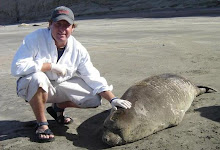
One of my fondest adventures in the region was with Dr. Claudio Campagna, director of the Wildlife Conservation Society's Sea and Sky Program. I joined Claudio on the Peninsula Valdes and with him had the opportunity to track down a tagged southern elephant seal Mirounga leonina using radio telemetry. The young seal in question also wore a satellite tag and our quest was to remove this tag to access the invaluable oceanographic data collected over a season at sea. In the picture above the young female is temporarily incapacitated after being tranquilized for the removal of the device. The photo here to the right was taken on one of Patagonia’s Estancias, which are large shepherding ranches.

The animal in my company is a young guanaco Lama guanicoe, one of South America’s four species of camel. This particular individual was semi-domesticated, living in association with the Estancia. However, these animals range wild throughout this landscape and are bountiful.

Looking ahead, I see the most challenging portion of this trek to be the lower third of the Argentine coast. It is a wild, harsh landscape with low human population density and miles upon miles of trackless, near-desert wilderness. It is this, and the unknown that lies therein, that draws me more than anything. I appreciate your help in moving this adventure forward and I look forward to sharing this time with you through this blog.

Photo Credits: Arlo and elephant seal (Natalia Machain), Maps of Argentina (Forum for the Conservation of the Patagonian Sea and Areas of Influence, www.worldatlas.com, MSN Encarta), Iguaçu Falls (Wikipidia), Arlo and guanaco (Rodolfo "Bubu" Werner)


12 March, 2009

Take a Walk on the Wild Side

Melbourne, Florida. For the past week, I've been traveling around coastal California. First stop was Monterey, followed by Los Angeles and then returning north to San Francisco. Despite the trip back west and the momentum from the recent television appearances, it looks like I'm going to spend at least another month here in Florida. Life has been good on the sleepy Space Coast and I'm getting a lot of writing done. So, I'm going to stay put for a bit.

Recently, I was considering changing the name of this blog and reformatting it for a wilderness theme. I've always enjoyed posting about my travels as well as sharing thoughts on conservation, exploration and why wilderness is so important. My time here in Florida has really brought this back to the forefront and I thought it might make more sense to streamline the theme for a particular audience (sorry, I don't mean to offend any of you Arlo Hemphill acting/wildlife enthusiasts, but the two are generally distinct interests - lol!). However, Where is Arlo Now?? has also been a great place to share performance clips on my acting and update you on my life in general. Now how could I do away with that?

I couldn't, so I've compromised. I've created a brand new blog dedicated to discussing wilderness exploration and conservation:


You can find this at http://walkwildside.blogspot.com or you can follow it via Facebook.

My camera has been busted for the past couple weeks, so at the moment the new blog is primarily story and newsfeed-oriented. However, I do intend to employ more of a vlog or vlog/blog format once the camera is repaired. Also, just as a heads up, there may be posts that I put on both Where is Arlo Now?? and Walk on the Wild Side. In particular, postings that focus on my personal explorations through wilderness areas might be relevant to both sites. Either way, I invite you to check the new site out!

Before I wrap this post up, I do want to comment on the above cheetah photo. I took this picture at the Nairobi Animal Orphanage in 2000. I had been visiting Kenya for a conference on mangroves, held in the coastal city of Mombasa. On the return trip, I spent a day in Nairobi and took the opportunity to visit Nairobi National Park. The orphanage is just outside the park boundaries and I was the only visitor that day. A friendly conversation started up with the facility's director and he invited me for a "special treat". The treat turned out to be a personal visit inside one of the cages where three cheetah cubs were being kept. Their mother had been shot on a local farm the week before and the orphans were brought here for care before hopefully being released back into the wild someday. I was able to spend some time playing with the cubs and this picture was my favorite from the experience.

08 March, 2009

Choke Patrica Arquette

San Francisco, California. Check out these recent television appearances of Arlo Hemphill on Medium and 1,000 Ways to Die. On Medium, Arlo briefly appears as the Assistant D.A. To view the episode, go to: http://www.nbc.com/Medium/video/episodes/#vid=1048870 . Arlo's scene is in the last "chapter" (or last 15 minutes if you are watching it on tv or via a different source). The scene is a party at the police station and D.A. Devalos (Miguel Sandovalis) is speaking with the medium, Allison Dubois (Patricia Arquette). Arlo approaches D.A. Devalos and leads him away for a phone call during the conversation.

On 1,000 Ways to Die, Arlo plays Karl, a dimwitted man who dies of asphyxiation during a cocoa powder food fight. Check out the scene via this clip: